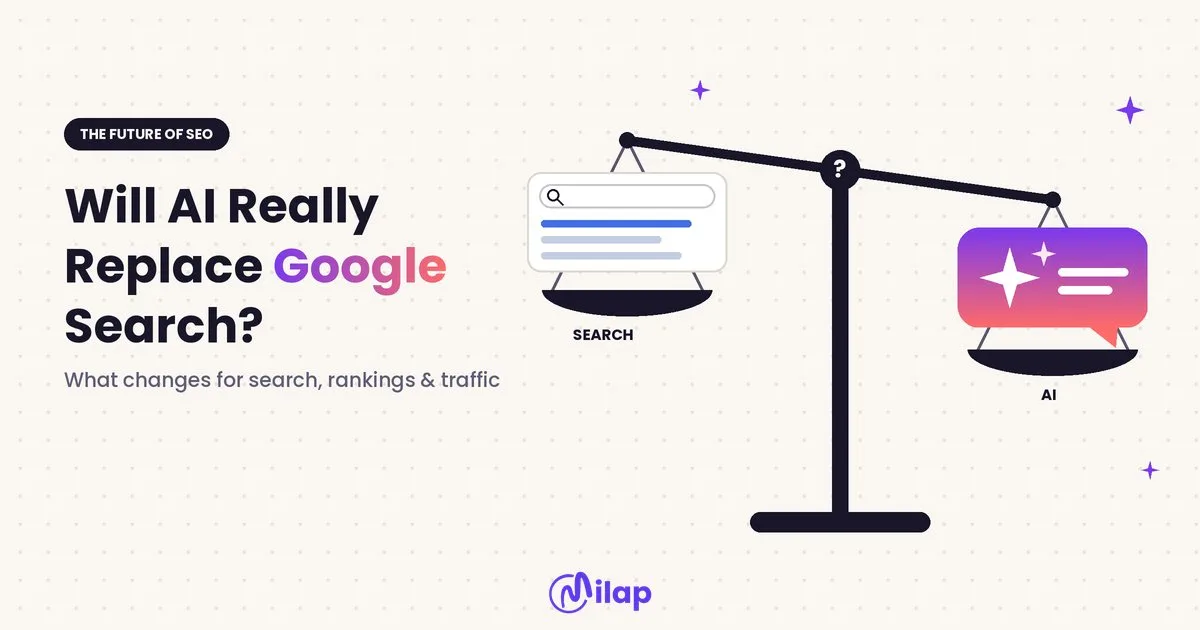
No, AI is not replacing Google search. Not this year, and probably not soon. But AI is replacing something that matters just as much to your business: the click.
People still search on Google more than ever. Yet more of those searches now end with an AI-written answer instead of a visit to your website. That shift, not the death of Google, is the real story behind the future of SEO.
This guide breaks down what the latest data actually shows. You will see where traffic is moving, which businesses are most exposed, and what to change in your SEO strategy now.
The Short Answer: AI Is Changing Google, Not Replacing It
Most “Google is dead” headlines mix up two different things. One is where people search. The other is what happens after they search.
On the first point, Google is fine. On the second, a lot has changed.
Google did not sit still while ChatGPT grew. It built AI directly into its results with AI Overviews and AI Mode. So the biggest AI search engine in the world today is, in practice, Google itself.
If you want a deeper look at how a conversational search engine works and why it answers questions differently from a list of links, start there. For this post, the key point is simple. AI search is not a rival channel to Google. It is now part of Google.
What the 2026 Data Actually Shows
Here is a snapshot of the numbers that matter. Treat company-reported figures as directional, since Google and OpenAI do not publish full methodology.
| Metric | Latest figure | Source |
|---|---|---|
| Google global search share | About 90% (April 2026) | StatCounter |
| ChatGPT weekly active users | About 900 million (Feb 2026) | OpenAI (company-reported) |
| Google AI Mode monthly users | Over 1 billion (May 2026) | Google (company-reported) |
| Google AI Overviews monthly users | Over 2.5 billion (May 2026) | Google (company-reported) |
| AI platforms’ share of all website traffic | About 0.32% | SE Ranking |
| Organic search share of all website traffic | About 42.75% | SE Ranking |
Google Still Owns Search Volume
Google held about 90.1% of worldwide search in April 2026, according to StatCounter. That figure was slightly higher than a year earlier.
Usage is growing too. In its Q3 2026 results, Alphabet said search query growth hit its fastest rate in five years. Revenue from Google Search and related products rose 12% to $63.35 billion.
There is a catch worth noting. PPC Land calculated that Search revenue grew by only $79 million versus the previous quarter. More searches did not translate into proportionally more revenue. That gap hints that AI answers may be changing how people click, even on ads.
AI Assistants Are Growing Fast, From a Small Base
ChatGPT is huge. OpenAI reported roughly 900 million weekly users in February 2026, up from about 400 million a year earlier.
But a large user base does not mean large referral traffic. SE Ranking found AI platforms drive about 0.32% of all website visits. Organic search drives about 42.75%. In other words, Google still sends roughly 134 times more visitors than all AI assistants combined.
A separate study of 16,661 websites by SEOcrawl found the same pattern. AI referrals grew 45% in a year. Yet sites still received only about 1.25 AI visits for every 100 Google visits.
The Real Threat: Fewer Clicks, Not Fewer Searches
If Google is growing, why are so many site owners seeing traffic fall? Because the search results page itself now answers more questions.
How AI Overviews Change Click-Through Rates
AI Overviews sit above the organic results. When they appear, users often get what they need without scrolling.
An Ahrefs study of 300,000 keywords found that pages ranking first had a 58% lower click-through rate when an AI Overview was present. It compared December 2023 with December 2025.
A randomized study of 1,065 Chrome users found a drop of roughly 40% in outbound clicks when an AI Overview appeared. That paper is still a working draft and has not been peer reviewed. Still, it is the first evidence that suggests cause, not just correlation.
Not every study is this bleak. Seer Interactive reported that AI Overview click-through rates partly recovered in early 2026. The direction is clear, but the size of the drop varies by industry and query.
Why Zero-Click Searches Matter for Your Business
SparkToro estimated that about 68% of U.S. Google searches ended without a click in early 2026. That study used Similarweb panel data from January to April.
Here is what that looks like in practice. A skincare brand ranks first for “is niacinamide safe with retinol.” Two years ago, that ranking drove steady blog traffic. Today, an AI Overview answers the question in three lines. The ranking holds. The clicks shrink.
SEOcrawl’s data backs this up. Across its sample, Google organic clicks fell about 15% year over year, even as rankings held for many sites.
Why the “Google Is Dead” Prediction Missed
In February 2024, Gartner predicted that traditional search engine volume would drop 25% by 2026 as people moved to AI chatbots. We are now in late 2026. That drop has not happened.
Google’s query volume grew instead. The prediction made one big assumption: that Google would stay the same while chatbots improved. Google didn’t stay the same. It absorbed AI into the product people already used every day.
This is the most useful lesson for planning your SEO. Distribution beats novelty. Billions of people already have Google as their default. They did not need to switch tools to start using AI search.
The prediction was wrong about volume. But it was right about the direction of value. More of the “answer” now happens on Google’s page instead of yours.
How SEO Is Changing in the Age of AI Search
SEO is not dying. The scoreboard is changing. Rankings still matter, but visibility inside AI answers now matters too.
| Old SEO focus | New SEO focus |
|---|---|
| Rank in the top 10 blue links | Rank and get cited in AI Overviews and AI Mode |
| Traffic as the main success metric | Visibility, citations, and conversions per visit |
| Target short keywords | Answer longer, conversational questions |
| One keyword per page | Cover a topic fully, including follow-up questions |
| Google is the only search engine that matters | Google first, plus ChatGPT, Gemini, and Perplexity |
| Content written for algorithms | Content written to be quoted by AI and trusted by people |
Google says the average AI Mode query is about three times longer than a traditional search. That changes how you research topics. You need to answer the full question, not just match a short phrase.
This is where generative engine optimization (GEO) comes in. GEO simply means structuring content so AI systems can understand it, trust it, and cite it. It is not a replacement for SEO. It is SEO with a new audience: the AI model reading your page.
What Still Works: The SEO Fundamentals AI Depends On
AI search tools do not invent knowledge from nothing. They pull from pages that are crawlable, clear, and trusted. That means the basics matter more, not less.
These fundamentals still drive results in both classic and AI search:
- Technical health: Pages must load fast, be indexable, and be easy for crawlers to read.
- Clear structure: Descriptive headings, short answers near the top, and tables help AI extract facts.
- Real expertise: First-hand experience, original data, and named authors build trust.
- Topical depth: Covering a subject fully beats publishing many thin pages.
- Brand strength: Branded searches still earn strong clicks, and AI tools favor well-known sources.
If you want a full checklist, review these SEO best practices that still hold up. And use an E-E-A-T content checklist before publishing anything in a competitive niche.
One more point is often missed. Commercial queries still earn clicks. People who search “pricing,” “near me,” or “best X for Y” usually want to compare options themselves. Building content around high intent keywords protects you from much of the AI Overview click loss.
Which Businesses Are Most at Risk?
AI answers hit some queries much harder than others. Here is a practical way to judge your exposure.
| Query type | Example | Risk from AI answers |
|---|---|---|
| Simple definitions | “What is a meta description” | High |
| How-to and explainers | “How to clean suede shoes” | High |
| Comparisons | “Shopify vs WooCommerce” | Medium |
| Local intent | “Dentist near me” | Lower |
| Transactional | “Buy waterproof hiking boots size 10” | Lower |
| Branded | “Allbirds return policy” | Lowest |
A publisher that lives on definition-style content faces real pressure. A local dental clinic or a Shopify store selling products faces much less. Its searchers still need to book, buy, or call.
The good news: visitors who do click from AI tools often arrive better informed. SE Ranking found AI-referred visitors spend 68% more time on websites than organic visitors. Adobe reported that AI-referred shoppers on U.S. retail sites converted 42% better than non-AI traffic in March 2026.
Treat these figures with care, though. A larger study of 973 ecommerce sites, published in Marketing Science, found ChatGPT referrals converting worse than most traditional channels. Your own data should decide, not industry averages.
How to Future-Proof Your SEO Strategy
You do not need to rebuild your whole strategy. You need to adjust where you focus effort. Here are the steps that make the biggest difference.
- Audit which pages trigger AI Overviews. Check your top informational keywords in Google. Note where an AI answer now appears above your listing.
- Rewrite key pages to answer first. Put a direct, two-sentence answer near the top. Then add depth, examples, and data below it.
- Add original value AI cannot copy. Use your own case studies, pricing data, photos, and expert opinions. Generic summaries are what AI replaces first.
- Shift more effort to commercial pages. Strengthen product, service, comparison, and location pages. These still earn clicks.
- Build brand mentions beyond your site. AI tools learn which brands to trust from reviews, forums, and press. A strong brand also lifts branded search.
- Track AI visibility, not just rankings. Check whether ChatGPT, Gemini, and Google AI Mode mention your brand for your core topics.
For a detailed, step-by-step playbook on the last two points, read our guide to improving brand visibility in AI answer engines.
Measure What Actually Matters Now
Traffic alone no longer tells the full story. A page can lose 30% of its visits and still bring in the same revenue if the remaining visitors are more qualified.
Shift your reporting toward these signals:
- Conversion rate by landing page and traffic source
- Impressions versus clicks in Google Search Console
- AI referral sessions from ChatGPT, Gemini, Perplexity, and Claude
- Branded search volume over time
Two quick definitions help here. Conversion rate shows how many visitors take the action you want. Click-through rate shows how many people who see your listing actually click it. When impressions rise but clicks fall, AI answers are often the reason.
For a broader framework, see our guide to measuring organic search visibility. Be aware that AI traffic is undercounted. Visits from ChatGPT’s apps often lose their referral data and show up as “direct.” Clicks from AI Overviews show up as normal organic clicks.
That is why a clean GA4 setup matters. If you are unsure whether your tracking separates AI traffic correctly, a certified Google Analytics expert can set up custom channel groups that capture it.
Where to Start This Month
If you only do three things, do these:
- List your 20 highest-traffic informational pages and check each for an AI Overview.
- Add a clear, direct answer to the top of the five pages losing the most clicks.
- Create a GA4 report that isolates AI referral traffic, so you can see the trend.
These steps take a few hours, not a full rebuild. And they give you real data to guide your next decisions.
The Bottom Line on the Future of SEO
AI is not replacing Google search. Google is becoming an AI search engine, and ChatGPT is growing beside it. Both still depend on websites for their answers.
What is changing is the value of a ranking. A top position earns fewer clicks than it did two years ago. The businesses that win will be the ones AI tools trust and quote, and the ones whose pages still earn the click when it counts.
The shift rewards depth, real expertise, and strong commercial pages. It punishes thin, generic content.
If you want a second opinion on how AI search is affecting your traffic, working with a freelance SEO expert can help you find the pages worth fixing first. Book a free digital marketing consultation, and we will review your search performance together.
FAQs
Will AI completely replace Google search?
Unlikely in the near term. Google still handles about 90% of global searches and has built AI directly into its results.
Is SEO dead because of AI?
No. AI search tools rely on well-structured, trusted web content, so SEO now also determines whether AI cites your brand.
How do AI Overviews affect website traffic?
They reduce clicks on informational queries. Ahrefs found a 58% lower click-through rate for top-ranking pages when an AI Overview appears.
What is the difference between SEO and GEO?
SEO helps pages rank in search results. GEO (generative engine optimization) helps content get understood and cited by AI tools like ChatGPT.
How can I track traffic from ChatGPT and AI search?
Use GA4 custom channel groups to isolate AI referrers. Expect undercounting, since some AI app visits appear as direct traffic.